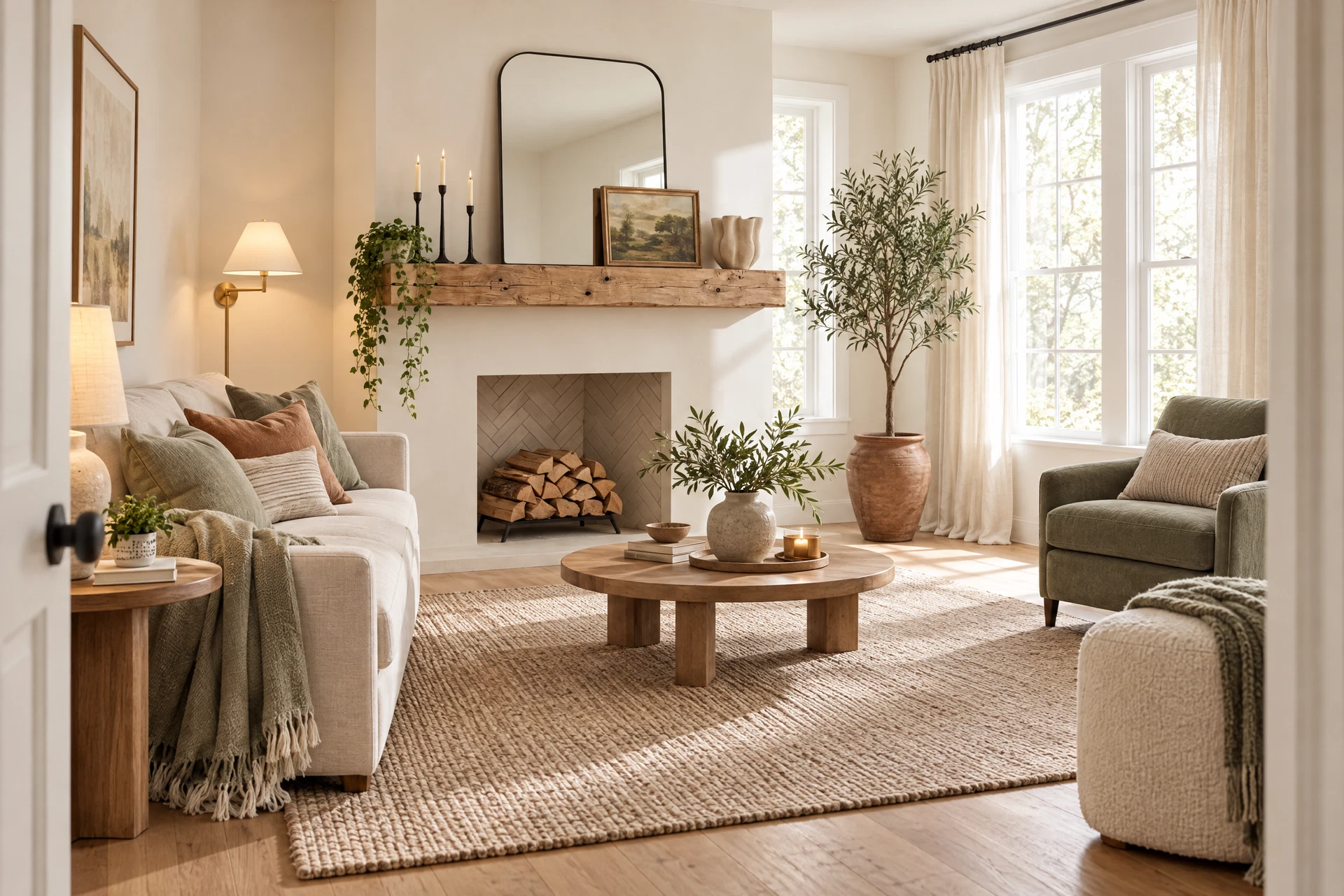
The quickest way to make a small living room feel bigger is often to stop looking at individual objects and start looking at the sequence of the room. What do you see when you walk in? Where does your body naturally want to go? Which piece makes you hesitate, squeeze past, or turn sideways?
Before buying anything, use the twelve ideas below in order. The first six are layout and visual decisions. The final six are optional purchases or small upgrades, so you can stop as soon as the room already feels better.
Start with the doorway view
1. Photograph the room from the entrance
Stand just inside the doorway and take a quick photo at eye level. Do not tidy for the photo. The image shows the first shapes your eye meets and often reveals why a room feels crowded: a sofa arm blocks the view, a tall shelf sits in the visual center, or the coffee table cuts across the walking path.
2. Give the main traffic path a clear line
Choose the route people actually use to reach a window, balcony, kitchen, or another room. Keep that route visually and physically clear. A useful starting point is about 30 inches of comfortable passage, adjusted for your household and the room’s real constraints. If that means rotating an armchair or moving a side table, try the free fix before buying slimmer furniture.
Test furniture footprints before moving the heavy pieces
3. Tape the footprint before you shop
Use painter’s tape or folded paper to mark the outer edges of a sofa, rug, coffee table, or storage unit on the floor. Walk around the tape at different times of day. Check the route while carrying a laundry basket, opening a window, or sitting down. The test is boring in exactly the helpful way: it exposes scale mistakes before they become returns.
4. Let one piece do the visual anchoring
A small room can still have a focal point, but too many competing anchors make it feel busy. Pick one: the sofa, a window, a picture ledge, or a lamp. Keep the remaining pieces quieter in shape or color so the eye can understand the room in one glance.
Make negative space do some work
5. Leave a little breathing room around furniture
Furniture pushed against every wall can make the perimeter look full while the room still feels awkward. Pulling a sofa a few inches from the wall can create a cleaner outline and give a lamp or curtain space to sit. This is not a rule to follow blindly; if the gap becomes a dust trap or blocks a radiator, return to function first.
6. Reduce the number of small visual stops
Group small objects instead of scattering them across every surface. One tray, one stack of books, and one low bowl usually read as a calmer composition than seven unrelated pieces. The goal is not minimalism for its own sake. It is fewer moments that make the eye stop and restart.
Draw the eye upward
7. Use a tall, quiet line
A curtain panel hung close to the ceiling, a narrow bookcase, or a tall plant can make the room’s vertical dimension more noticeable. Keep the line relatively slim and avoid filling every shelf. In a rental, a freestanding piece or tension-mounted curtain solution can create height without drilling; check your lease and the surface before installing anything.
8. Hang art with a clear relationship to the furniture
A single larger piece or a small, deliberate grouping often feels less cramped than many tiny frames floating apart. Center the arrangement on the furniture below it, not on the entire wall. If you are unsure, lay the frames on the floor first and photograph the arrangement before hanging.
Let warm, layered light create depth
9. Replace one bright ceiling moment with two lower layers
A ceiling fixture can flatten a room when it is the only light source. Add a table lamp, floor lamp, or plug-in wall light so the room has light at more than one height. Our warm-light buying guide covers bulb warmth, shade shape, cords, and practical placement.
10. Light the corner you actually use
Instead of lighting every corner equally, place light where you read, talk, or put your feet up. A useful pool of light makes the room feel intentional and lets quieter areas recede. That contrast can feel more spacious than a fully bright room.
Choose optional purchases carefully
11. Consider one leggy or double-duty piece
Visible floor under a console, chair, or side table can keep the room’s footprint readable. A storage ottoman can work as a footrest and a place for blankets. But do not buy a multi-use item if it performs each job badly; a shallow open basket may be more useful than a bulky piece that promises six functions.
12. Use a rug to connect, not chop up, the seating area
A rug can make a small room feel more coherent when at least the front legs of the main seating sit on it. If a full-size rug is not in the budget, try a smaller washable layer under the coffee table only if it does not create a visual island. Measure first, and remember that a slightly imperfect bare floor is better than a rug that makes the path unsafe.
Photograph the doorway view, tape the footprints, clear the path, group the small objects, adjust the light, then decide whether one purchase solves a real problem. This order protects your budget from buying décor to compensate for a layout issue.
Rental and budget alternatives
Borrow a side table before buying one. Use a floor lamp instead of rewiring. Try removable hooks only on surfaces your lease and the product instructions allow. Turn a pretty storage basket toward a wall if its contents are visually noisy. And if the room is already safe and functional, leave some empty space alone; the cheapest spaciousness is often the space you do not fill.
Conclusion: make the room easier to read
A small living room does not need to look empty to feel bigger. It needs a clear first view, a path that makes sense, furniture that passes the tape test, a few intentional pauses, and light that adds depth. Once those foundations are in place, the optional purchases become easier to judge.