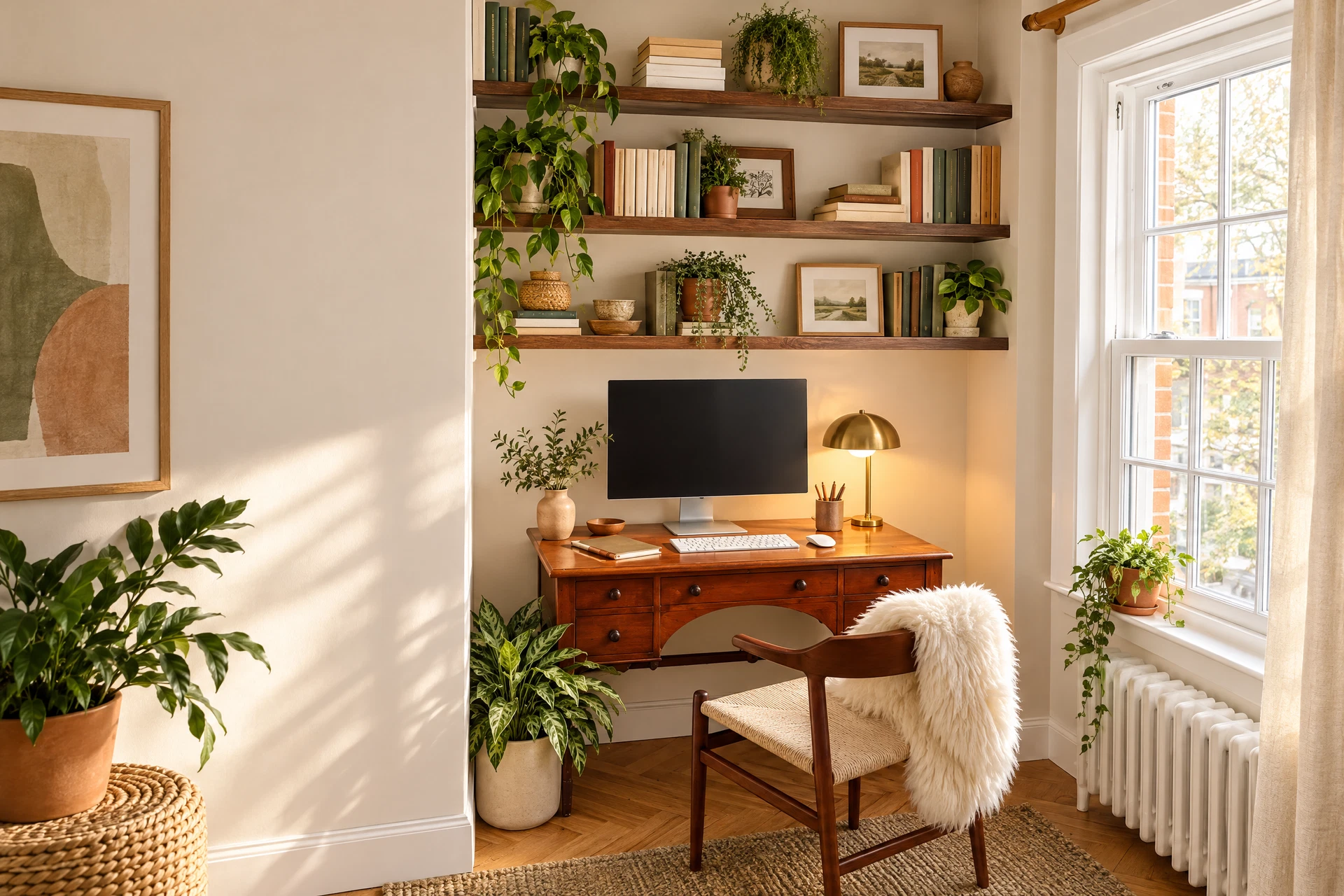
A small home office has to do two jobs at once: support focused work and disappear gracefully when the work is done. That is why the prettiest desk photo is not always the most useful model. A workspace can look calm and still leave you fighting a drawer, a cable, or a chair that blocks the room.
These cozy home office ideas begin with function and add warmth only where it helps. Try them in order, stopping when the space feels easier rather than treating twelve as a shopping list.
Start with the footprint
1. Choose the smallest desk that supports the work
Write down what must stay on the desk during a normal work session: laptop, monitor, notebook, lamp, drawing tools, or a cup. Measure that arrangement before buying a desk. A shallow surface can feel more generous than a deeper one that forces the chair too far into the room.
2. Tape the desk and chair before moving furniture
Mark the desk edges and chair pull-out zone with painter’s tape. Walk past it while carrying laundry, opening a door, or reaching a window. If the tape blocks the natural route, solve the placement before bringing in storage. Our small living room space audit uses the same doorway-first logic for a reason: circulation is part of comfort.
3. Keep one side visually quiet
A small workspace feels calmer when one edge can recede. That might be a plain wall, a curtain, or the side of a bookcase with fewer objects. You do not need to decorate every visible surface; one quiet boundary helps the useful things stand out.
Make the light kind to your eyes and your mood
4. Put the task light on the non-dominant side
Place a lamp so your working hand does not cast a shadow across the page or keyboard. Check the lamp’s reach and switch location before you commit. A small adjustable shade is usually more useful than a large decorative lamp that takes up the only clear corner.
5. Add warmth without making the desk dim
Use a comfortable task light for the work surface and a softer lamp or ambient source elsewhere in the room. This creates depth without asking one bulb to do everything. The warm-light buying guide explains how bulb warmth, shade material, and light height change the feeling of a room.
6. Protect the screen from a harsh window angle
Before rearranging the room, watch the light at the times you actually work. If the screen catches glare, try rotating the desk or using a soft curtain layer. A modest adjustment can be more effective than adding another lamp.
Hide the workday without hiding the tools
7. Give cables a short, visible route
Do not chase a perfectly invisible cable system if it makes unplugging difficult. Group the cables that need to stay together, keep the route close to a desk leg, and leave enough slack to move the laptop or clean. A small cable box can help, but only if it has ventilation and still lets you reach the plugs.
8. Use one landing tray for daily tools
A shallow tray can hold a notebook, headphones, and the pen you actually use. When the workday ends, move the tray to a shelf or cabinet. The action creates a clear visual boundary without requiring a full desk clear every evening.
9. Store supplies vertically
A narrow file holder, wall pocket, or upright box can use height instead of valuable desktop depth. Group supplies by task rather than by object type: invoices, sketching, calls, or packing. The best category is the one that lets you put something away with one hand.
Add cozy details that earn their space
10. Choose one soft layer
A small seat cushion, washable throw, or fabric pinboard can soften a workspace without adding clutter. Choose the layer that solves a real discomfort—cold chair, hard wall, or echoing corner—rather than adding texture by habit.
11. Let one personal object be the visual pause
Pick one object you enjoy seeing: a small print, a postcard, a plant, or a piece of pottery. One meaningful pause often gives the room more personality than a row of decorative accessories that need dusting.
12. Make the chair easy to leave
If the chair is heavy, visually loud, or difficult to tuck away, the office will remain present even when work is finished. Look for a chair that supports your posture and can move without scraping the floor. In a rental, use a small mat only if it does not create a trip edge or interfere with the desk footprint.
Put the notebook in its tray, return the pen, route the charging cable, close the laptop, and switch off the task light. If those actions feel awkward, the workspace still needs a small layout fix.
Small-space and rental alternatives
A desk does not have to be a desk-shaped piece of furniture. A narrow console, a fold-down surface, or a shelf at the right height may work if it supports the real equipment and leaves a safe route. For a rental, prefer freestanding storage, leaning art, and removable organization products only after checking the surface and the lease. Our reversible rental decorating guide labels changes as surface-free, removable, or permission-dependent.
When the room still feels crowded
Remove one category before buying another container. Clear old paperwork, duplicate cables, or décor that has migrated onto the desk. Then look at the chair route, the lamp height, and the screen angle again. A small workspace often needs fewer decisions, not more storage.
Conclusion: make work easier to leave
The coziest home office is not the one with the most accessories. It is the one where the work fits, the light feels comfortable, the tools have a home, and closing the day takes a few repeatable movements. Start with the footprint, soften the light, control the cables, and add only the details that help you stay or leave with intention.